Table of Contents
When you start learning Carnatic music, everything feels exciting. You're learning new ragas, discovering your favorite musicians, and maybe even dreaming of performing on stage someday. But as you practice more, you'll notice something important: some days your voice feels easy and natural, while other days it feels like you're fighting with every note.
Often, the reason is simple: you haven't found the right sruthi in carnatic music for your voice. Sruthi in carnatic music is basically your starting pitch, your home base, the "Sa" that everything else is built around.
It's not just a random setting on your tanpura app. It's the one pitch where your voice can breathe easily and sing comfortably. When you get it right, practice becomes smoother, your voice sounds more like you, and music feels less like hard work and more like joy.
What Does Sruthi Mean for You as a Singer?
In classical texts, sruthi in carnatic music has detailed definitions about pitch divisions. But for a vocalist, it has a simpler, more personal meaning: it's your tonic pitch, your Sa, the base you sing from.
What matters most:
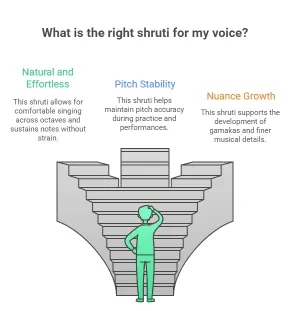
- Sruthi in carnatic music is the pitch where your voice feels natural and effortless
- It's the note you can return to without tension
- It's the foundation for your entire sense of pitch
Unlike Western classical music, Carnatic music doesn't force one fixed standard. There's no universally correct Sa, only the Sa that's right for your voice, at this stage of your journey.
Benefits of the Right Sruthi
Why Getting Your Sruthi Wrong Causes Problems
Choosing the wrong sruthi in carnatic music can hurt your progress more than you think. Many beginners pick a pitch that "sounds good" without testing if it truly fits their voice.
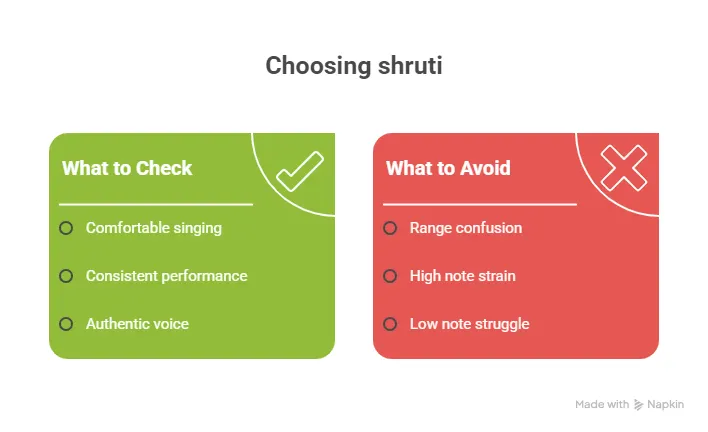
Signs Your Sruthi Is Too High
- Throat feels tight on higher notes
- Constantly stretching to reach phrases
- Voice tires quickly and recovers slowly
Signs Your Sruthi Is Too Low
- Voice sounds dull or fuzzy
- Swaras lack clarity in fast passages
- Lower octave feels heavy and unstable
The biggest damage is often psychological. When sruthi in carnatic music is mismatched, you may think: "Maybe I'm just not good at this" or "Why doesn't my voice behave like others?" Often, it's not about your hard work or skill, it's simply that the foundation wasn't set right.
Range vs. Comfort: Understanding the Difference
One common confusion is mixing up what your voice can do with what it can do comfortably.
You might think:
- "I can hit that high note, so I should set my sruthi there"
- "I can touch that low note, so let me fix my sruthi lower"
But those extreme notes are at the edge of your range, not the center. Your sruthi in Carnatic music should sit in the middle of your comfortable singing range, where your voice sounds natural and you can sing for 30-45 minutes without tiring.
Think of it this way: your full range is like how far you can stretch your arms, but your sruthi is where your hands naturally rest when relaxed.
Step-by-Step Guide to Finding Your Sruthi
Step 1: Start with Your Speaking Voice
Speak a comfortable sentence, then hum the general pitch of your speaking voice. This gives you a starting point. You don't need the exact note name yet, just where your voice naturally sits.
Step 2: Use a Tanpura or Shruti Box
A tanpura online or shruti box online free tool becomes your sonic mirror.
Here's how to explore:
- Set the device to a pitch near your comfortable hum
- Sing Sa slowly and hold it for a few seconds
- Listen: do the sounds blend, or are you constantly adjusting?
Ask yourself:
- Does my throat feel relaxed holding Sa?
- Can I keep the note steady, or does it wobble?
- Do I feel an urge to slide up or down?
If your Sa matches the drone and feels peaceful, that's a good sign.
Pro Tip: You can use the free tanpura online tool available at Spardha School of Music website for accurate practice. It's a simple, browser-based tool that gives you a steady drone without needing to download any app.
Step 3: Test Both Octaves
A common mistake is choosing sruthi in carnatic music that feels good only in the middle octave.
Simple test:
- Sing Sa-Pa-Sa in the middle octave
- Move down to mandara Sa (lower Sa)
- Float up to tara Sa (higher Sa) without forcing
Pay attention:
- Does lower Sa feel heavy or breathy?
- Does upper Sa feel tight or squeezed?
A good sruthi in carnatic music lets you touch both extremes gently, without reaching your absolute limit.
Step 4: Notice How Your Body Feels
After 20-30 minutes of basic practice, check:
With well-chosen sruthi in carnatic music, your voice should feel supported, not abused.
Step 5: Test with Simple Material
Don't test sruthi in carnatic music with complex ragas or kritis. Keep it simple:
- Hold Sa in the middle octave
- Sarali varisais in slow speed
- Simple patterns like Sa-Ri-Ga-Ma
If these basics feel clean and comfortable, you're on the right track.
Click below and take the quiz to know your improvements in Carnatic Singing!

Typical Sruthi Ranges (Reference Only)
These are tendencies, not rules. Your vocal texture, health, and natural pitch matter more than gender. Use these only as reference points, never as pressure.
Common Mistakes to Avoid
What beginners often do wrong:
- Copying a favorite singer's sruthi
- Singing higher than comfortable to sound "powerful"
- Relying only on apps instead of listening to the drone
- Ignoring throat fatigue or pain
- Changing sruthi casually every few weeks
Remember: Sruthi in carnatic music is not a status symbol or competition. It's simply the most honest place for your voice.
The Role of Technology
Electronic tanpura apps, shruti box music tools, and tuners are genuinely helpful but use them wisely.
Healthy approach:
- Use devices to set and sustain your chosen sruthi
- Close your eyes and listen, don't stare at screens
- Let your body and ear be the primary judges
- Use technology as support, not master
Your goal is to carry sruthi in carnatic music within you to hum Sa confidently even in silence.
Click on the blog below to understand the swaras in Carnatic Music!

How a Good Teacher Makes a Difference
While self-exploration helps, a trained ear catches things you miss. A good guru listens to whether you're "on pitch" and to hidden tension in how you produce that pitch.
At Spardha School of Music, we offer 1:1 live personalized online classes to learn Carnatic music from home under the guidance of expert certified and professional teachers. Our instructors help students identify their ideal sruthi in carnatic music, protect voices from long-term damage, and build strong foundations that make the entire musical journey smoother and more enjoyable. With personalized attention in every session, we ensure each student develops healthy vocal habits from the very beginning.
What a Teacher Can Do
- Hear subtle strain in your notes
- Suggest small sruthi shifts that make huge differences
- Protect you from damaging habits early on
Many singers later realize their struggles came from incorrect sruthi in early years. A few focused sessions to fix this can transform your entire practice.
Building Daily Sruthi Awareness
Like any skill, what is shruti in music awareness grows with consistent attention.
Daily practice tips:
- Begin every session with a few minutes of prolonged Sa
- Sing slowly and mindfully
- Spend a moment recalling Sa internally before switching on the drone
- When listening to senior musicians, notice how their voice sits in their sruthi
Over time, this builds a strong internal compass. You'll quickly sense when something is off.
Learn about the king of Ragas in the blog below!

Conclusion
Identifying your sruthi in carnatic music is not a one-time task. It's an ongoing conversation with your voice, a process of listening carefully and respecting your limits as much as your potential.
Almost everything that matters later, intonation, stamina, improvisation, even your joy in music, rests on this foundation. When you find the right sruthi in carnatic music, you're not just choosing a pitch; you're choosing a home.
Take time to explore patiently. Trust what your body says, not what your ego wants. Once your sruthi is set well, every exercise, raga, and composition you learn will feel more natural because you're building on ground that truly belongs to you.
Frequently Asked Questions
Q: What is sruthi in carnatic music?
Sruthi in Carnatic music is the fundamental musical pitch or tonal foundation. It's your base note (Sa) from which all other notes are organized. It represents the precise frequency that sounds pleasant to your voice and serves as the reference for staying in tune.
Q: What is the concept of shruti?
Shruti (meaning "that which is heard") refers to fundamental, subtle musical pitches that form the basis of melodies in Indian classical music. It's like a root note with 22 microtonal divisions that provide nuanced expression beyond just 12 Western notes.
Q: Is sruti the same as a note?
No, sruti is not the same as a musical note (swara). A sruti is a microtonal interval, the smallest pitch gradation the human ear can detect. A swara is a selected, prominent pitch used to construct scales and melodies.
Q: How do I sing in correct sruthi?
Start by finding your comfortable base note (Sa) with a tuner or shruti box. Practice Sa-Pa-Sa exercises to lock in the pitch. Consistently match the drone sound, record yourself to self-correct, and always use a reference while learning. Develop a stable vocal range and maintain relaxed posture and breathing.